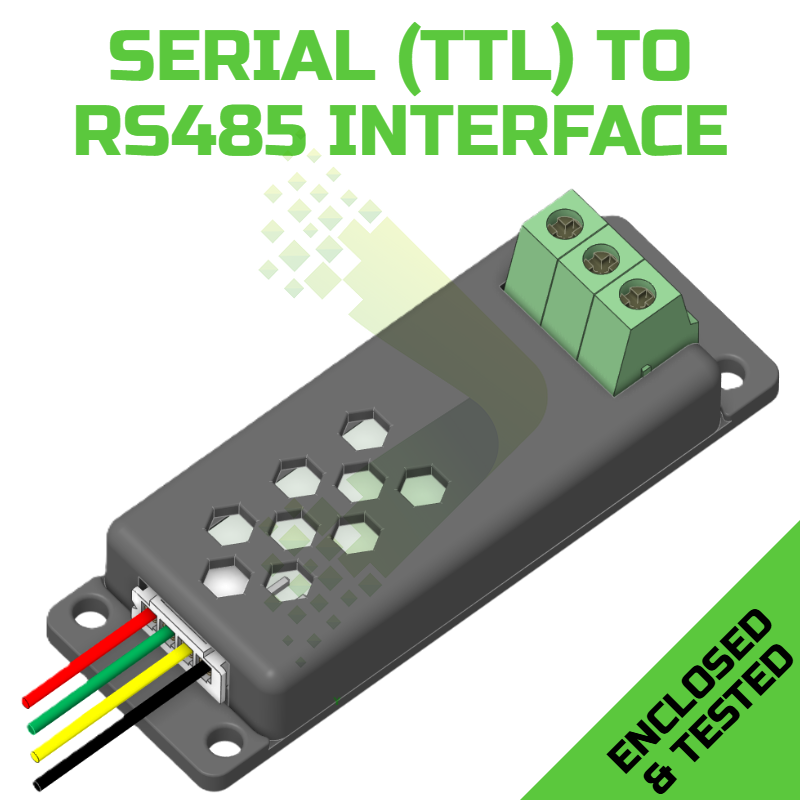
A ready-to-wire TTL to RS485 converter, supplied with proper connectors and a protective enclosure. No soldering, no direction-control pin, no fiddling with flying leads.
This module lets a microcontroller, single-board computer, or USB-serial adapter talk to RS485 equipment: Modbus sensors, energy meters, VFDs, industrial controllers, and long-distance serial links. RS485 carries data reliably over distances and through electrical noise that would defeat an ordinary serial connection entirely.
Most converter boards on the market arrive as a bare PCB with a row of unpopulated header holes, and expect you to solder your own wires and drive a direction-control pin from a spare GPIO. This one does neither. It has a keyed JST-XH connector on the TTL side, a screw terminal on the bus side, automatic direction switching in hardware, and it comes in a box.
Key Features:
- Automatic Direction Control: No DE/RE pin to drive and no transmit-enable code to write. Your software simply writes to the serial port as it would to any other device.
- MAX485 Transceiver: The industry-standard RS485 device, rated from -40 to +85 degrees C.
- 3.3V and 5V Compatible: Works directly with ESP32, Raspberry Pi, Pico, STM32, Arduino, and USB-serial adapters.
- JST-XH 4-Way Connector: Keyed, secure, and impossible to plug in backwards. A mating fly lead is supplied in the box, so there is nothing to solder and nothing else to order.
- 3-Way Screw Terminal: GND, B- and A+ on the bus side, including the ground reference that most modules leave out.
- 120 Ohm Termination Fitted: Correct as supplied for a device at the end of the bus.
- Supplied in an Enclosure: 69 x 24 x 15 mm. Nothing exposed to short against a panel, a cable tray, or a stray strand of wire.
- Tested Before Dispatch: Every unit is functionally tested on our own bench before it is packed, and carries a TESTED OK mark. Data transfer is verified in both directions, along with bus termination resistance and operation on both supply voltages.
- Up to 32 Devices: One controller can address up to 32 devices on a single bus.
- Long Cable Runs: Up to 1200 metres at lower baud rates, far beyond the reach of plain TTL serial.
- Tested 9600 to 115200 Baud: Covers Modbus RTU and the overwhelming majority of RS485 equipment.
- Half Duplex: Send and receive over a single twisted pair.
Connections
- TTL Side, JST-XH 4-Way (from the top): GND, RXD, TXD, VCC. Remember that serial connections cross over, so the module's RXD goes to your controller's TX.
- RS485 Side, 3-Way Screw Terminal (from the top): GND, B-, A+.
Applications
- Modbus RTU Equipment: Energy meters, PLCs, temperature controllers, inverters, and variable frequency drives.
- Long-Distance Serial: Where a TTL or RS232 link would fall far short of the distance needed.
- Industrial Sensors: Soil, weather, level, flow, and pressure transmitters.
- Building Systems: Access control, lighting, HVAC, and irrigation controllers.
- Multi-Drop Networks: One controller addressing many devices over a single pair of wires.
- Electrically Noisy Sites: Workshops, factories, and farms, where differential signalling rejects the interference that defeats single-ended serial.
Important: Read Before Wiring
- Supply Voltage and 3.3V Controllers: The TXD output swings to whatever you supply on VCC. If you power the module from 5V and connect TXD straight to an ESP32, Pico, or STM32, you are applying 5V to a pin that is not 5V tolerant and may damage it. Power the module from 3.3V when working with 3.3V controllers, or fit a divider on the TXD line.
- Always Connect the Ground: RS485 is differential, but it is not immune to voltage differences between devices. Running only A and B, with no ground reference between equipment on separate supplies, is behind a large proportion of unreliable RS485 installations. Run the third wire.
- Termination on Multi-Drop Buses: An RS485 bus needs approximately 120 ohms at each of its two ends and nowhere else. If you fit three or more of these modules on one bus, the units in the middle must have their 120 ohm resistor removed, or the bus will be overloaded and unreliable.
- A and B Labelling: Manufacturers are inconsistent about which line is A and which is B. If a device will not communicate, swap them. No damage results from having them reversed.
A full datasheet with pinout diagram, wiring guidance, bus design notes and a troubleshooting table is available: download the NDE-1001 datasheet.
Why Choose This Converter? A bare RS485 breakout costs a little less and then costs you an afternoon: soldering flying leads, working out which GPIO to sacrifice for direction control, debugging why the last character of every message disappears, and finding somewhere safe to mount a naked PCB. This one arrives finished, and tested. The connectors are fitted, the direction switching happens in hardware, the termination is already correct for an end-of-line device, and the whole thing is in a box. Whether you are reading a Modbus energy meter, driving an inverter, or running a sensor network across a farm, it is the difference between a component and a part you can simply install.