
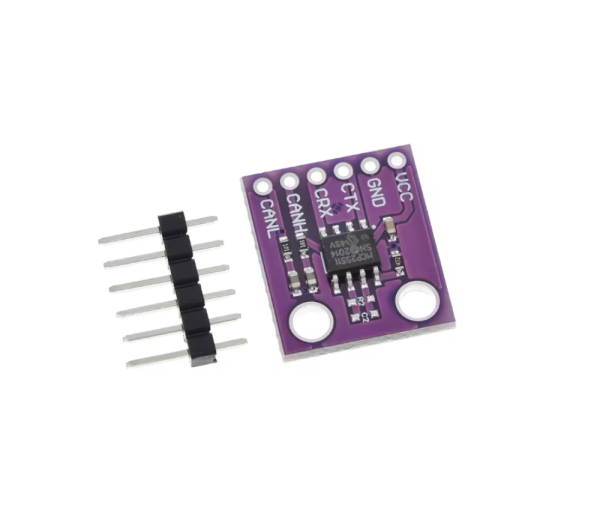

The MCP2551 High-speed CAN Protocol Controller is a CAN transceiver IC designed to connect microcontrollers to a CAN bus for robust vehicle and industrial network communication. It is based on the Microchip MCP2551 CAN transceiver and suits hobbyists, students and engineers building networked control systems, automotive projects and industrial monitoring applications.
How It Works
The MCP2551 sits between your microcontroller’s CAN controller (which speaks the CAN protocol in software) and the physical two-wire CAN bus. It converts the logic-level TX and RX signals from your microcontroller into the differential CANH and CANL signals that travel along the bus, and vice versa, allowing multiple nodes to communicate reliably even in electrically noisy environments.
Key Features
- Compact breakout board with 2.54mm pin headers for breadboard use
- Power supply: 5V on VCC pin
- CAN bus connections: CANH and CANL differential pair
- Microcontroller interface: TX (transmit) and RX (receive) logic pins
- Supports CAN 2.0B at speeds up to 1Mbps
- Transceiver IC: Microchip MCP2551 in SOIC-8 package
- Operating voltage: 4.5V to 5.5V
- Differential output voltage: typical 2V
- High immunity to electromagnetic interference
- Short-circuit protection on CANH and CANL pins
- Thermal shutdown protection
Applications
- Automotive projects: connecting Arduino or ESP32 to a vehicle CAN bus to read engine data or dashboard signals
- Industrial control networks: linking sensors, actuators and controllers in a factory or machine
- Multi-node systems: building your own CAN network for robotics, home automation or distributed sensing
- Education: learning about CAN bus communication and automotive protocols
Good to Know
- This board is a physical-layer transceiver only – your microcontroller must have a built-in CAN controller (like ESP32, STM32, Teensy) or use an external CAN controller IC such as the MCP2515.
- CAN bus networks require 120Ω termination resistors at each end of the bus – check whether your board includes one or whether you need to add it externally.
- Works with 5V logic; if using a 3.3V microcontroller, check that its CAN controller outputs are 5V-tolerant or use level shifting on the TX and RX lines.


Reviews
There are no reviews yet.